Equipment Inspection vs Comprehensive Inspection in Japan
— A Complete Guide to Fire Protection Compliance Cycles
If you own, manage, or invest in real estate in Japan, you will eventually encounter two terms that sound similar but mean very different things: Kiki Tenken (機器点検 — Equipment Inspection) and Sōgō Tenken (総合点検 — Comprehensive Inspection). Both are mandated under Japan’s Fire Service Act, and missing either one exposes you to administrative orders, fines, and — in the worst case — civil liability if a fire occurs.
This article explains, in plain English, what each inspection covers, how often it must be performed, who is qualified to perform it, and how reporting cycles differ depending on the type of building. The content is based on Article 17-3-3 of the Fire Service Act (消防法) and Article 31-6 of the Ministerial Ordinance for Enforcement of the Fire Service Act (消防法施行規則).
1. The legal foundation — Article 17-3-3 of the Fire Service Act
Under Article 17-3-3 of Japan’s Fire Service Act, the “person concerned” with a building (typically the owner, manager, or occupier) where fire protection equipment is installed must:
- Conduct periodic inspections of fire protection equipment
- Report the results to the fire chief having jurisdiction
The detail of “periodic” — what gets inspected, how, and how often — is delegated to the Ministerial Ordinance and to public notices issued by the Commissioner of the Fire and Disaster Management Agency. This is where the two-tier inspection system comes in: every fire protection installation in Japan must be checked twice a year, but the depth of the check alternates between Kiki Tenken and Sōgō Tenken.
Two inspections, two reports — but they are linked
Inspection (the technical work) and reporting (the legal filing) are separate obligations. You can complete an inspection and still be out of compliance if the report is not filed on time.
2. Equipment Inspection (Kiki Tenken) — the six-month integrity check
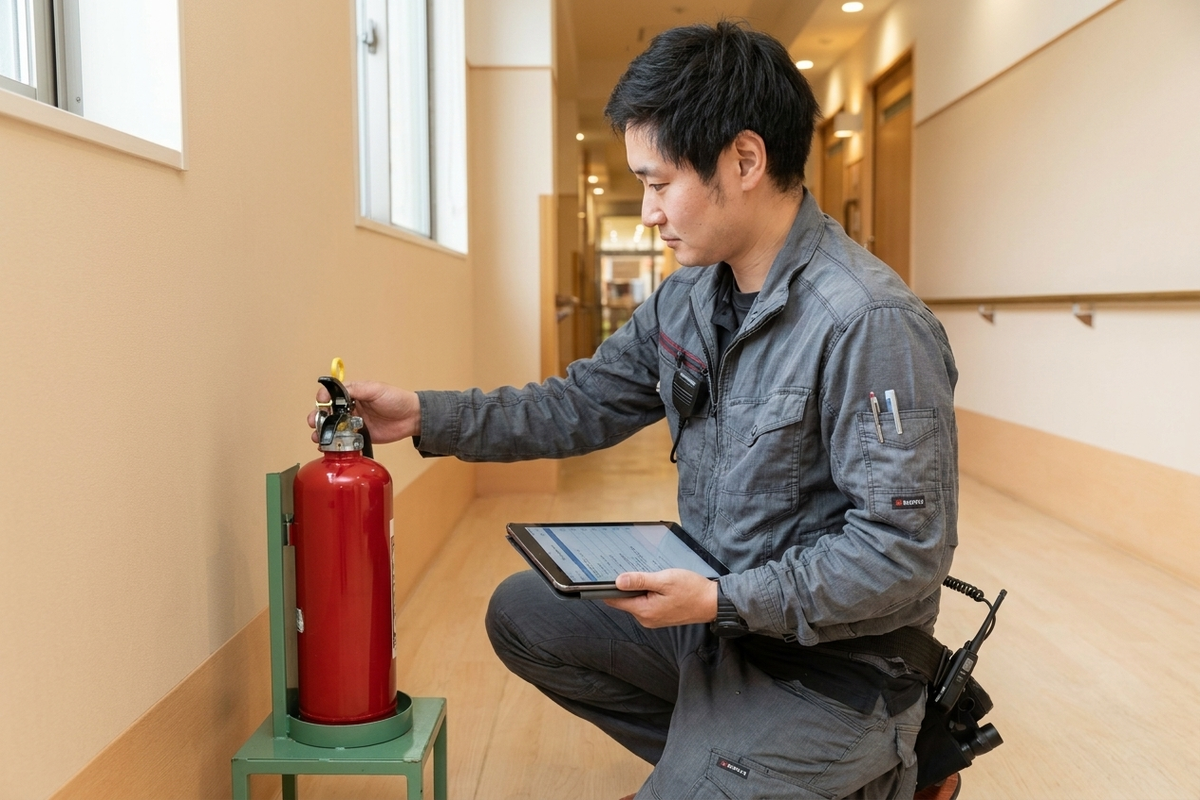
Equipment Inspection is a routine visual and basic-operation check performed every six months. Its purpose is to confirm that the installed fire protection equipment is in place, undamaged, and apparently ready to function.
Typical Kiki Tenken activities
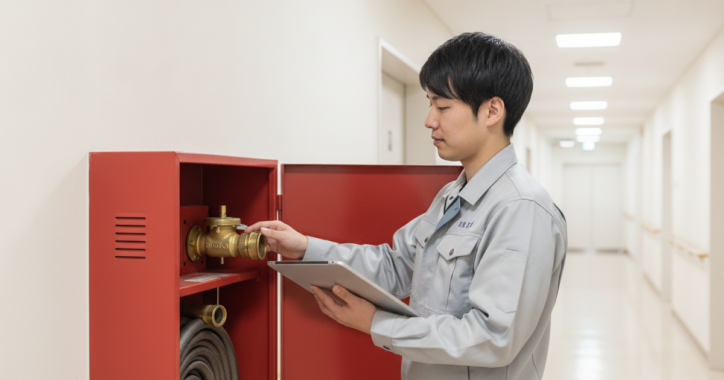
- Visual checks of fire extinguishers — pressure gauge, body corrosion, expiration date, location signage
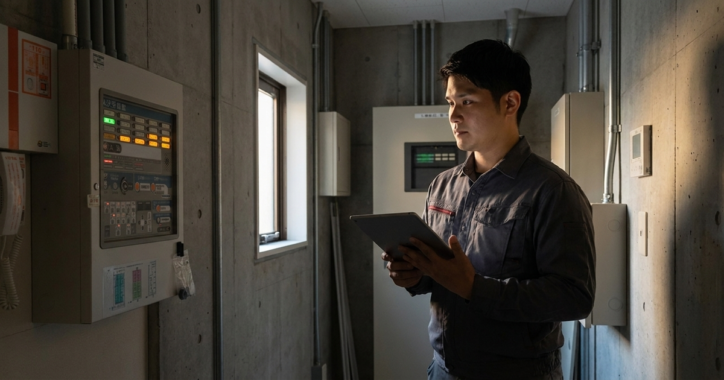
- Confirming indicator lamps on the fire alarm receiver panel
- Operating switches and selector valves by hand to confirm response
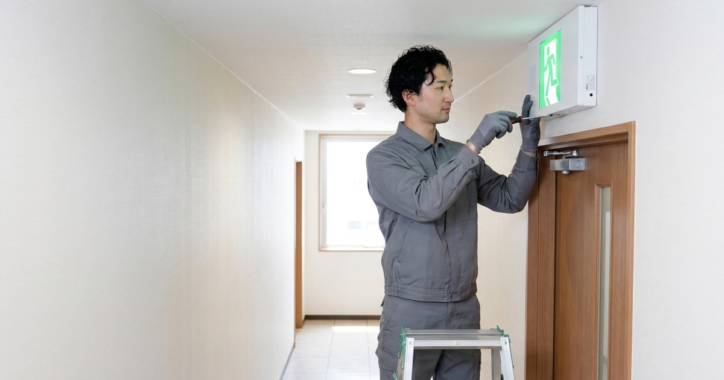
- Checking emergency exit signs for illumination and battery indicator
- Verifying access to fire hydrants, hose reels, and sprinkler control valves
- Confirming that storage of inspection records and signage is intact
The inspector does not normally trigger the equipment into a full operational state during Kiki Tenken. Think of it as: “are the parts present, intact, and apparently ready to work?” — a fast, frequent integrity check that catches obvious damage, missing components, or expired consumables before they become problems.
3. Comprehensive Inspection (Sōgō Tenken) — the annual functional test
Comprehensive Inspection is the deeper functional test performed once a year. It overlaps with Kiki Tenken in scope but goes further by actually operating the equipment and verifying that it performs as designed.
Typical Sōgō Tenken activities
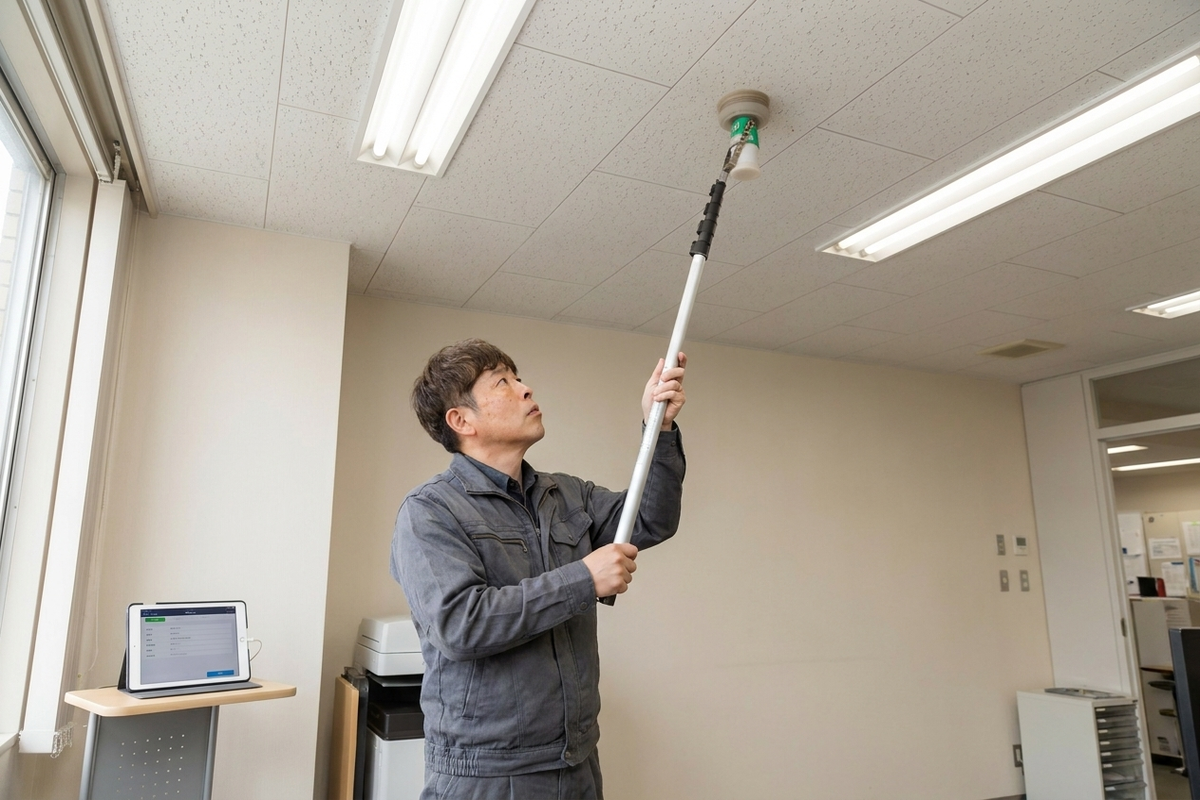
- Heat and smoke detector activation tests using a heat-test pole or smoke-test gas to verify alarm response
- Discharge tests on fire hydrants and sprinkler systems to confirm pressure and flow
- Internal inspection of fire extinguishers at the prescribed intervals (e.g., 5 years for stored-pressure extinguishers, 3 years for chemical-foam types)
- Operating fire shutters, smoke vents, and fire doors to confirm closure and movement
- Live test of the fire alarm receiver with input signals from each detection zone
- Function test of emergency power sources (batteries, generators) for fire equipment
Because Sōgō Tenken places equipment into actual operation — including water discharge and shutter movement — it requires careful coordination with building tenants, often after-hours scheduling, and it is generally performed by qualified personnel with specialized tools.
4. Reporting cycles — annual vs triennial
Inspection and reporting are two different obligations. The inspections themselves run on a six-month / twelve-month rhythm, but the reporting cycle to the fire chief depends on the building’s classification under the Cabinet Order Annex Table 1 (令別表第一).
| Item | Specified Fire Prevention Object (特定防火対象物) |
Non-Specified Fire Prevention Object (非特定防火対象物) |
|---|---|---|
| Inspection cycle | Every 6 months (Kiki) + every 12 months (Sōgō) | Every 6 months (Kiki) + every 12 months (Sōgō) |
| Reporting cycle | Once a year | Once every three years |
| Typical examples | Hotels, ryokan, hospitals, restaurants, shopping centers, theaters, childcare/elderly care, mixed-use buildings | Office buildings, factories, warehouses, schools, common areas of residential apartments, religious facilities |
| Underlying logic | Used by an unspecified general public — higher evacuation risk | Used by a defined population familiar with the building |
Note that inspection records must be kept on site even in years when no report is filed. Fire department officers conducting on-site visits routinely ask to see the most recent inspection records, regardless of when the next report is due.
5. Who can perform the inspection?
Japan distinguishes between buildings that must use a qualified inspector and those where the building owner may self-inspect.
Cases requiring a qualified inspector
A qualified inspection by a Fire Equipment Officer (消防設備士 / Shōbō Setsubishi) or a Fire Equipment Inspection Qualified Person (消防設備点検資格者 / Shōbō Setsubi Tenken Shikakusha) is required when:
- The building is a Specified Fire Prevention Object with a total floor area of 1,000 m² or more, or
- The building is a Non-Specified Fire Prevention Object of 1,000 m² or more that is specifically designated by the fire chief, or
- The building has any system whose self-inspection is impractical (e.g., emergency power, smoke control)
Self-inspection cases
Below these thresholds, the building owner or manager may carry out the inspection themselves — but in practice, most owners outsource to a licensed firm. The reasons are straightforward: liability exposure, the technical complexity of Sōgō Tenken, and the volume of paperwork required for the report.
Penalties for skipping inspection or reporting
Article 44 of the Fire Service Act provides for fines of up to 300,000 yen or up to 30 days of imprisonment for willful non-compliance with a fire chief’s order, with additional liability under Article 45 for legal entities. More importantly, missed inspections can become decisive evidence in civil proceedings if a fire occurs.
6. Common misunderstandings and compliance tips
Three patterns we see frequently in the field:
“We just had Kiki Tenken — we’re fine.”
No. Sōgō Tenken still has to happen at its own annual cycle. The two are additive, not interchangeable.
“Office buildings only inspect every 3 years.”
No. Inspection is twice a year. Reporting is once every three years. Don’t confuse the two cycles.
“No problems found, so nothing to file.”
The report itself is the legal obligation. Even a clean inspection must be filed to close the compliance loop.
“The previous owner handled all this.”
Inspection and reporting obligations transfer with ownership. Confirm the latest report on file before you take possession.
Practical compliance tips for international owners
- Set calendar reminders at six-month and twelve-month intervals tied to your acquisition date
- Ask your inspection vendor for an English-language summary alongside the Japanese statutory report
- Keep the most recent two inspection records on site (paper or PDF) for fire department visits
- If you operate multiple buildings, request a portfolio-level dashboard showing next inspection / next report dates
- Confirm whether your building falls in the 1,000 m² threshold — many mixed-use buildings unexpectedly qualify
Need help with your fire inspection compliance in Japan?
TechBuilCare has more than 40 years of experience in Japan’s fire protection inspection industry, with offices in Osaka and Tokyo serving clients nationwide.
We provide both Equipment and Comprehensive Inspections, qualified-inspector reporting, and English-language documentation for international owners and asset managers.